
Industry EPD or product-specific EPD: when the average is no longer enough
Key Summary
- An industry EPD declares one shared value for the whole industry, either the average or the worst case, so a better product does not show up in it.
- Certifications make product-specific EPDs valuable: in BREEAM V7, an EPD for a specific product earns 1.5 points instead of 0.5, and in DGNB a better product directly improves the result of the building LCA.
- According to a 2024 survey by DGNB and BPIE of 59 construction product manufacturers, 44 % use industry EPDs, but the study shows a trend towards product-specific EPDs.
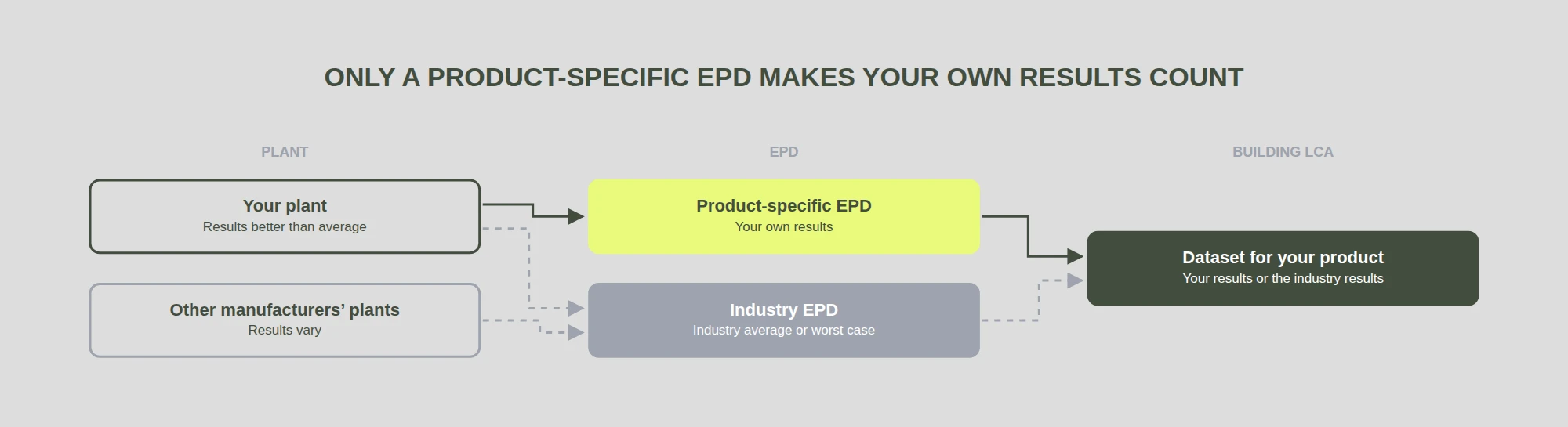
Two manufacturers supply a similar product, and both have better environmental values than the industry average. Manufacturer A has its own Environmental Product Declaration (EPD), so in the building life cycle assessment (LCA) the project team uses A's good value. Manufacturer B is covered by the industry EPD of its trade association, so for B's product the project team uses the industry average. Both products are equally good, but in the building LCA, B looks worse.
Many manufacturers today are covered by an industry or association EPD. It is an affordable way to get started, and for some products it is enough. But with building certifications, the EU Energy Performance of Buildings Directive and the new Construction Products Regulation, what increasingly counts is the value of your own product.
This article explains what each type of EPD delivers, when an industry EPD is still enough, and when a product-specific EPD pays off.
1. Industry EPD and product-specific EPD at a glance
The industry EPD (often also called an association EPD) and the product-specific EPD, a manufacturer's own EPD, are both verified EPDs according to EN 15804+A2. The difference lies in whose product they describe.
| Industry EPD | Product-specific EPD | |
|---|---|---|
| Published by | Trade association | One manufacturer |
| What it represents | Industry average or worst case | A manufacturer's own products |
| Verification | External verification according to ISO 14025 | External verification according to ISO 14025 |
Both types are common. In ÖKOBAUDAT, the German federal database for building LCAs, around 43 % of the manufacturing datasets in September 2024 were product-specific EPDs and 24 % were industry EPDs, with generic data making up the rest (DGNB and BPIE, 2024).
2. Industry EPDs: what they deliver and when they are enough
2.1 What an industry EPD delivers
An industry EPD keeps your product from being modelled with generic data. Without an EPD, project teams use values from databases such as ÖKOBAUDAT or the Dutch NMD, which deliberately include a safety margin of up to 30 %. With an industry EPD, they use verified industry values instead.
Many manufacturers take this route: in a survey by DGNB and BPIE of 59 construction product manufacturers, 44 % said they use industry EPDs (2024). The manufacturers share the costs, often through their association, which lowers the cost per company. This way they meet the basic requirement that an EPD exists for their product.
Industry EPDs come in two variants: as an industry average, or as a template EPD that deliberately represents the worst case, meaning the product with the highest environmental impacts (as described by ÖKOBAUDAT and the Institut Bauen und Umwelt). A simplified example: three manufacturers have values of 80, 100 and 120 kg CO₂ equivalents per tonne. An average EPD declares 100 kg for all of them, a template EPD 120 kg. With a product-specific EPD, the best manufacturer could show its 80 kg.
How well the average describes your product depends on the spread. The programme operator EPD Global (formerly EPD Norge) does not limit how far the values of participating manufacturers may differ in an industry EPD. It only recommends stating the range (2022).
2.2 When an industry EPD is enough today
From our conversations with manufacturers, we know that an industry EPD is enough today mainly in three cases:
- Your customers do not ask for product-specific data.
- Your product is highly standardised, and the manufacturers' values are close to each other.
- Your target markets do not require product-specific values for tenders and certifications.
This can change quickly, though. In our experience, customers increasingly ask for product-specific values, and building certifications reward them, as section 3 shows. There is also the Construction Products Regulation (EU) 2024/3110: with it, environmental data will gradually become part of the declaration of performance (more on this in our article on CPR environmental indicators).
3. Product-specific EPDs: what they deliver
A product-specific EPD brings the value of your product into the building LCA. This lets you respond to customer requests, make a better product visible, earn points in building certifications and improve your products in a targeted way.
3.1 Responding to customer requests
We keep hearing that customers explicitly ask for product-specific EPDs, for example when building data centres. If you cannot meet such a request, you risk losing the order. Collecting data and creating a product-specific EPD only at that point usually takes too long. If your most important products are already covered, you can deliver right away.
3.2 Visibility for a better product
An average makes good values invisible. According to EPD Global, an industry EPD rewards the plants with the worst results and penalises the best. A study by DGNB and BPIE also finds that manufacturers with an industry EPD cannot use environmentally better products to set themselves apart from competitors. With a product-specific EPD, on the other hand, improvements become visible too: if a manufacturer switches to green electricity, for example, it can show the better value directly with an updated EPD. In an industry EPD, this advantage is lost in the average.
The interviews in the study show a trend towards product-specific EPDs. This trend is not limited to Germany. In Italy, tile manufacturers are covered by the industry EPD of their association Confindustria Ceramica, which represents more than 82 % of Italian production. Even so, in our conversations with manufacturers we have seen a shift towards product-specific EPDs since 2024. For example, the tile manufacturer Ceramiche CCV Castelvetro, itself a member of Confindustria Ceramica, has published a product-specific EPD for its tile collection “Outfit 2.0”. The main reason manufacturers give is public tenders under the Italian environmental criteria CAM, followed by competition: as soon as one manufacturer stands out with a product-specific EPD, others follow so as not to fall behind.
3.3 Building certifications
In DGNB, points are awarded for the result of the building LCA. Project teams are expected to use EPDs of the products actually installed (DGNB criteria set for new construction, version 2023.2, criterion ENV1.1). With a product-specific EPD, a product that performs better than the industry average therefore directly improves the result.
In BREEAM V7, the EPD type itself also counts. In criterion Mat 02, which awards points for EPDs of installed products, an industry EPD earns 0.5 points and a product-specific EPD 1.5 points. For manufacturers supplying BREEAM projects, this is a direct advantage. You can find the details in our article How EPDs score in BREEAM.
3.4 Analysing and improving products
With the data from a product-specific EPD, you can analyse your products. The LCA behind it shows where the largest environmental impacts arise, the so-called hotspots. On platforms like Emidat, you see them broken down by life cycle stage and material and can tell where improvements pay off. According to DGNB and BPIE, 32 % of the manufacturers surveyed have already initiated changes in production based on their LCA results (2024).
4. Decision guide: five questions and three steps
Five questions show whether a product-specific EPD pays off for your products:
- Do your customers ask for product-specific data?
- Do tenders or certifications in your markets require product-specific EPD values?
- Does your product differ clearly from competitors in its formulation or production?
- Do you want to stand out from competitors with your environmental data?
- Do you want to know where to start improving your product?
If you answer yes to several questions, we recommend a product-specific EPD. These three steps help you get started:
1. Check existing EPDs
If your industry EPD is listed in ÖKOBAUDAT, the type is stated in the dataset (Average, Representative or Template). If it is a template EPD, it represents your product as the worst case. In Emidat Atlas and in the ECO Platform's ECO Portal, you can also see which competitors have already published product-specific EPDs.
2. Start with your most relevant products
A product-specific EPD is most relevant for products you sell in large volumes, that contribute a lot to the building LCA, or that are particularly environmentally friendly. Start with these product lines and with the markets where customers already ask for EPD values today.
3. Automate your EPD creation
Today, product-specific EPDs can be created efficiently, even for large product portfolios. The trend is towards platforms like Emidat that automate the creation. Manufacturers upload their data in bulk and create product-specific EPDs themselves, without additional verification costs per EPD.
FAQ
Do I need a product-specific EPD if my association has an industry EPD?
Yes, if your product is better than the industry average. Only with a product-specific EPD does your own value go into the building LCA. On top of that, there are customers who explicitly ask for product-specific data, and certifications like BREEAM, where an EPD for a specific product earns 1.5 points instead of 0.5.
Is an association EPD a real EPD?
Yes. Like any EPD, an association or industry EPD is created according to EN 15804+A2 and externally verified according to ISO 14025. However, it does not describe a single product but declares a shared value for the industry, either the average or the worst case.
Does an industry EPD count in DGNB?
Yes. In version 2023.2, DGNB allows ÖKOBAUDAT and verified EPDs according to EN 15804 for the building LCA and does not distinguish between EPD types. Points are awarded for the result of the building LCA. A product-specific EPD therefore helps if its values are better than the average.
Can I use an industry EPD and a product-specific EPD at the same time?
Yes, for different products. It makes sense, for example, to cover your most important products with product-specific EPDs and to use the industry EPD for the rest. We recommend telling project teams clearly which EPD applies to which product.