
CPR environmental indicators: full list, timeline, and compliance
Key summary
- What indicators does the CPR require? 19 environmental indicators based on CPR Annex II that are identical to the ones required by EN15804+A2.
- When do they become mandatory? In three phases: GWP from January 2026, core indicators from January 2030, and all indicators from January 2032..
- How can manufacturers prepare? By building an automated process for creating verified EPDs based on EN 15804+A2 and the relevant PCRs/cPCRs, covering all 19 indicators from day one.
Under the new Construction Products Regulation (CPR), manufacturers will need to declare not only technical performance data, but also environmental data to obtain the CE marking. This environmental data becomes a core part of the new Declaration of Performance and Conformity (DoPC), which will feed directly into the Digital Product Passport (DPP).
But what exactly do manufacturers need to declare, and when does this become mandatory? The CPR defines a specific set of 19 environmental indicators in Annex II that are identical to the indicators from EN 15804+A2, and will be phased in over three milestones between 2026 and 2032. This article gives you the full list, explains the timeline, and helps you understand how to prepare for compliance.
1. Environmental indicators under the CPR
The CPR lists 19 environmental indicators in Annex II, labeled (a) through (s). These indicators are identical to the environmental indicators defined in EN 15804+A2, the European standard for Environmental Product Declarations (EPDs) in construction. All of them will eventually need to be declared by manufacturers in the DoPC.
Full list of environmental indicators
Here is the full list of environmental indicators mentioned in Annex II of the CPR, including abbreviation and unit:
| CPR Letter | Indicator | Abbreviation | Unit |
|---|---|---|---|
| (a) | Climate change effects – total | GWP-total | kg CO₂ eq. |
| (b) | Climate change effects – fossil fuels | GWP-fossil | kg CO₂ eq. |
| (c) | Climate change effects – biogenic | GWP-biogenic | kg CO₂ eq. |
| (d) | Climate change effects – land use and land use change | GWP-luluc | kg CO₂ eq. |
| (e) | Ozone depletion | ODP | kg CFC-11 eq. |
| (f) | Acidification potential | AP | mol H⁺ eq. |
| (g) | Eutrophication aquatic freshwater | EP-freshwater | kg P eq. |
| (h) | Eutrophication aquatic marine | EP-marine | kg N eq. |
| (i) | Eutrophication terrestrial | EP-terrestrial | mol N eq. |
| (j) | Photochemical ozone | POCP | kg NMVOC eq. |
| (k) | Abiotic depletion – minerals, metals | ADPE | kg Sb eq. |
| (l) | Abiotic depletion – fossil fuels | ADPF | MJ, net calorific value |
| (m) | Water use | WDP | m³ world eq. deprived |
| (n) | Particulate matter | PM | disease incidence |
| (o) | Ionising radiation, human health | IRP | kBq U-235 eq. |
| (p) | Eco-toxicity, freshwater | ETP-fw | CTUe |
| (q) | Human toxicity, cancer | HTP-c | CTUh |
| (r) | Human toxicity, non-cancer | HTP-nc | CTUh |
| (s) | Land use related impacts | SQP | dimensionless (pt) |
What indicators are already included in an EPD?
If you already have an EPD calculated according to EN 15804+A2, you are well positioned: it already includes all 19 indicators required by the CPR.
It is worth noting that in today's EPD landscape, indicators may be calculated slightly differently depending on the Product Category Rules (PCRs) of different program operators (e.g. EPD Global, EPD International, or IBU). The harmonised standards under the CPR will unify this, with the aim of making environmental data in DoPCs comparable across products and markets. This makes it significantly easier for manufacturers to operate in several EU markets and use environmental data to their advantage.
2. Timeline: when indicators become mandatory
The CPR does not require all 19 indicators at once. Instead, the regulation defines three phases. In each phase, more indicators become mandatory across all EU member states. Individual member states can also make additional indicators mandatory ahead of schedule, which could be the case in countries where EPDs are already used in national regulation and public procurement today.
The three phases of mandatory indicators

Phase 1: GWP Indicators
Mandatory from 8 January 2026
Indicators (a) to (d), the four Global Warming Potential (GWP) indicators, must be declared as part of the DoPC. This is the first set of environmental indicators ever required for obtaining the CE marking.
Phase 2: Core Indicators
Mandatory from 9 January 2030
Indicators (e) to (m) become mandatory, expanding the scope to include ozone depletion, acidification, eutrophication, photochemical ozone formation, abiotic resource depletion, and water deprivation. Together with Phase 1, this brings the total to 13 mandatory indicators.
Phase 3: All Indicators
Mandatory from 9 January 2032
The remaining indicators (n) to (s) become mandatory, adding particulate matter, ionising radiation, ecotoxicity, human toxicity, and land use impacts. From this date, all 19 indicators must be declared.
When does this apply to my products?
The obligation to declare environmental data for a specific product applies once the relevant harmonised standard (hEN) has been updated under the new CPR and becomes mandatory. The European Commission's standardisation work plan determines which product families are prioritised (see more here).
The three phases above set the earliest possible date each indicator group can become mandatory, but the actual obligation for your products depends on when your product's harmonised standard is updated. Here is the process for developing the new harmonised standards:

That said, the direction is clear: environmental data will become a mandatory part of CE marking for construction products. The question is not if, but when your product family will be affected.
Strategic advantage of early adoption
There is a strategic advantage to declaring the DoPC with environmental indicators as early as possible. Today, manufacturers selling into different markets (e.g. France or the Netherlands) often need to create separate EPDs following different national calculation rules and program operator requirements. Once environmental data is declared through the harmonised DoPC under the CPR, this data is valid across all EU member states – replacing the need for multiple country-specific declarations with a single, unified set of environmental data.
3. Verification of environmental indicators under the CPR
The CPR requires that environmental data declared in the DoPC is verified by Notified Bodies (NBs). This represents a shift from the current system, where verification is handled by program operators such as EPD International or IBU. Many of these program operators are already working on their accreditation under the EU system of Notified Bodies or establishing partnerships with them.
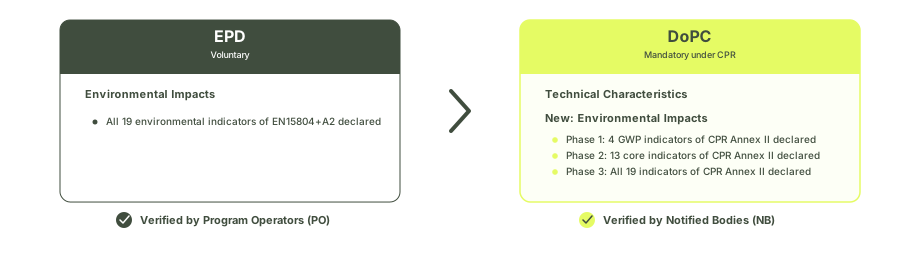
Automated EPD platforms such as Emidat have integrated verification of environmental data and will automatically adapt to the DoPC verification requirements.
4. How to prepare for CPR compliance
The phased timeline gives manufacturers a window to build up their environmental reporting capabilities – a window that should not be underestimated. Here is how to start:
1. Build your data collection processes now.
The main challenge is not the LCA calculation. It is collecting primary data on energy consumption, raw material inputs, transport distances, and waste streams from your production processes. This takes time to set up, and the earlier you start, the smoother the transition.
2. Follow relevant calculation rules (PCRs / cPCRs) and verification guidelines (independent third parties).
Your environmental data must be calculated according to the applicable PCRs / cPCRs and verified by an independent third party. Data that does not meet these requirements will not be accepted for the DoPC under the CPR. Starting with a verified EPD based on EN 15804+A2 is the easiest way to build up a process that ensures this.
3. Calculate the full indicator set, not just GWP.
Focusing only on GWP means covering 4 of 19 indicators. When Phase 2 adds 9 more indicators, that process will need to be fundamentally expanded. A full LCA covers all 19 indicators from the start and avoids rework. In addition, individual EU member states can require environmental indicators before the EU-wide deadlines - for example in public tenders. Having the full indicator set ready prevents losing access to these markets.
4. Start automating early.
With 19 indicators across potentially dozens of product variants, manual LCA processes become unmanageable. Platforms that automate LCA calculations and EPD generation let you scale environmental reporting without increasing your team size.
Can I use a PCF for full CPR compliance?
No. A Product Carbon Footprint (PCF) covers only greenhouse gas emissions (GWP) and does not necessarily adhere to standardised calculation methodologies (PCRs / cPCRs). Limiting your efforts to GWP alone means your values will change if you are not considering standardised calculation and verification rules. Additionally, you will need to fundamentally expand your environmental reporting process when Phase 2 kicks in with 9 additional indicators. Building a process around a PCF creates a gap that will require significant adaptation later. This is a risk for manufacturers that plan to deeply integrate such a workflow into their processes and systems.
A full LCA based on EN 15804+A2 (which is the basis for an EPD today) covers all indicators from day one and avoids this problem entirely. A PCF is only a subset of such an LCA - read more here.
5. The bigger picture: how the DoPC feeds into the Digital Product Passport
The Digital Product Passport (DPP) is an EU-wide initiative that creates a structured digital record of a product's data, accessible to everyone in the value chain, from manufacturer to building operator to demolition contractor. For construction products, the CPR mandates the DPP and requires the DoPC to be included in the DPP. Think of the DPP as a digitised DoPC with additional information.
The DPP goes beyond what the DoPC alone requires. While the DoPC covers technical performance characteristics and the environmental indicators, the DPP is designed to carry all digital product information: details on hazardous substances, materials composition, recyclability, and end-of-life guidance, such as maintenance and repair instructions, relevant for circular economy decision-making.
For manufacturers, the implication is clear: building a robust process for calculating environmental data is the basis for CPR compliance and an important data layer within the DPP.
How Emidat can help
Emidat is the leading platform trusted by over 150 manufacturers to automate the creation of PCFs, LCAs, EPDs, and DPPs in-house – without requiring prior LCA expertise. By building your environmental reporting process on Emidat, you can cover all 19 CPR indicators from day one and be ready for every phase of the regulation.