
CSC certification for concrete: levels, modules and the role of EPDs
Key Summary
- The Concrete Sustainability Council (CSC) certifies concrete, cement and aggregate plants at four levels from Bronze to Platinum; in Germany, the system is run by the German ready-mixed concrete association (Bundesverband der Deutschen Transportbetonindustrie e. V., BTB).
- The R module (R for recycling) and the CO2 module rate and label individual concrete mixes in classes of one to four stars; the CO2 module requires 30 to 60 % less CO2 than the national reference value.
- The annex to the CSC Technical Manual V3.0 lists the Emidat EPD tool as an accepted LCA tool; in the CO2 module, verified EPDs count as evidence without an additional plausibility check.
In our experience, ready-mixed and precast concrete manufacturers are increasingly asked by customers whether their concrete is CSC certified. The question comes from projects certified under DGNB, BREEAM or LEED that recognise the CSC, and from tenders that require a CSC level or an add-on module. Manufacturers who cannot show the required certificate are usually ruled out as suppliers. This expert article explains how CSC certification and its two add-on modules work, why the requests end up with manufacturers, and how and where Environmental Product Declarations (EPDs) serve as evidence.
1. What the CSC is and what it certifies
The Concrete Sustainability Council (CSC) is an international certification system for the concrete supply chain. It assesses how responsibly a plant and its suppliers operate in environmental, social and economic terms. The CSC works worldwide through regional system operators, including in Austria, Germany, Italy, Belgium, the Netherlands, the USA and Turkey. In Germany, the regional system operator is the German ready-mixed concrete association (BTB).
1.1 Points and levels
The CSC system is a product certification system that usually covers all products a plant makes and delivers. What is certified is therefore the individual plant, not a single product. The Technical Manual V3.0 of 5 December 2025 groups the criteria into six areas: prerequisites, management, environment, social, economy and supply chain. Each criterion has a maximum score, for example 6 points for environmental product information (criterion E1) or 20 points for occupational health and safety (criterion S3). A concrete plant can score 175 points in total, a cement plant 233 and an aggregate plant 165. The result is expressed as a percentage of the achievable points.
The supply chain counts too. A ready-mixed concrete plant's result is made up 60 % of the assessment of its own plant, 25 % of the CSC certificates of its cement suppliers and 15 % of those of its aggregate suppliers. A supplier without a CSC certificate contributes zero points, so a ready-mixed concrete plant without a certified supply chain misses 40 % of the achievable points (see the introduction to the CSC certification system V3.0, in German). The level a plant receives depends on the percentage of achievable points it reaches, and the thresholds differ by plant type:
| Level | Concrete plants | Cement plants | Aggregate plants |
|---|---|---|---|
| Bronze | from 35 % | from 60 % | from 60 % |
| Silver | from 50 % | from 75 % | from 75 % |
| Gold | from 65 % | from 90 % | from 85 % |
| Platinum | from 80 % | from 95 % | from 95 % |
For example, a concrete plant that reaches 55 % of the achievable points receives Silver. Without certified suppliers, a ready-mixed concrete plant reaches at most 60 % and so cannot go beyond Silver. On top of this, there are minimum requirements for the levels from Silver upwards that must be met regardless of the score. For Silver, the plant needs documented environmental, quality and occupational safety management. For Gold, at least 98 % of materials must come from traceable sources, and an EPD must be available (criterion E1.01), either an industry EPD or the plant's own. For Platinum, 75 % of the cement and 75 % of the aggregates (each by mass) must also come from suppliers that themselves hold at least CSC Gold.
1.2 How certification works
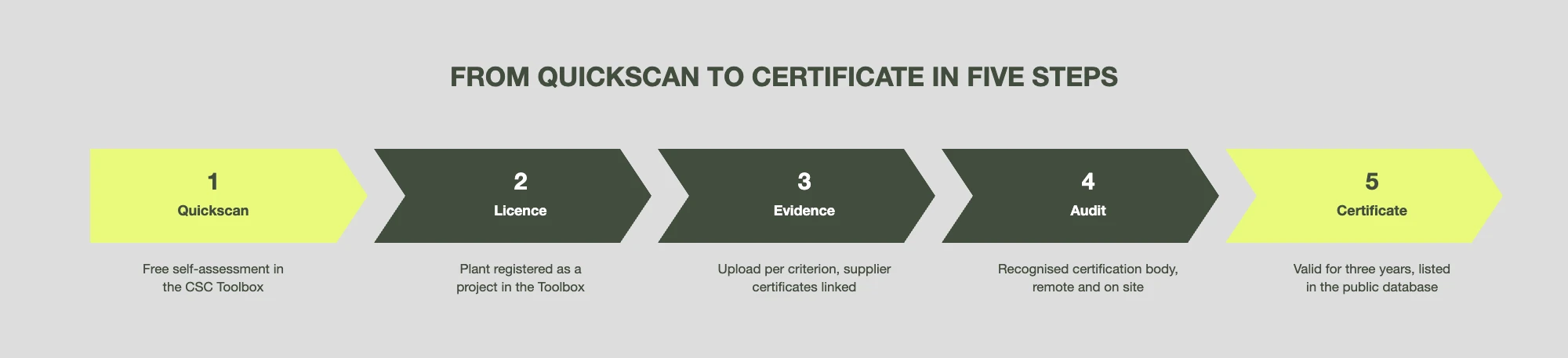
Figure 1: From Quickscan to certificate in five steps.
Certification runs through an online platform, the CSC Toolbox. There, a plant can first carry out a free and optional Quickscan, a self-assessment across all criteria. It takes about 20 minutes and shows which level is likely to be achievable. For the actual certification, the plant buys a licence, uploads the evidence for each criterion to the Toolbox and has it checked by a certification body recognised by the CSC. The certificate is valid for three years from issue and appears in the public CSC database. The costs consist of the licence fee, the auditor's fee and the plant's own staff time (CSC FAQ).
2. The two add-on modules: R module and CO2 module
Besides the certification of the plant, there are two add-on modules. They do not assess the plant but individual concrete mixes. Both require the plant to hold at least CSC Silver. Both modules award four levels (Level 1 to 4, shown as one to four stars). The level achieved appears either on the delivery note or on an accompanying document that refers to the delivery note, so the customer on site can see what was delivered. The modules have no effect on the score of the main certificate. In our observation, when CSC is part of a tender, the add-on modules are often requested as well.
2.1 R module
The R module labels concrete in which part of the aggregate is replaced by R material. What is assessed is the share of R material in the aggregate volume of a mix. The Technical Manual R module V2.1 names three types of R material: recycled aggregate from processed construction material, manufactured aggregate and reclaimed aggregate from unused fresh or hardened concrete. Supplementary cementitious materials such as ground granulated blast-furnace slag or fly ash are not R material.
Besides CSC Silver, the module requires that at least 98 % of the R material (by mass) comes from traceable sources and that purchased R material is certified to local standards. The levels depend on the minimum share of R material in the aggregate volume:
| R module | Minimum share of R material in the aggregate volume |
|---|---|
| Level 1 (1 star) | 10 % |
| Level 2 (2 stars) | 20 % |
| Level 3 (3 stars) | 40 % |
| Level 4 (4 stars) | 80 % |
2.2 CO2 module
The CO2 module labels concrete with reduced greenhouse gas emissions. What is assessed is by what percentage the CO2 value of a mix (in kg CO2e/m³) lies below the national reference value for its compressive strength class. The reference values are set per country. For Germany, they are given in the BTB's background report on the CO2 module (in German), derived from the industry EPDs of the InformationsZentrum Beton. The CO2 value of the mix must come from a life cycle assessment (LCA). Section 4 shows which evidence the CSC accepts for this.
Besides CSC Silver and the LCA, the module has two further requirements: at least 75 % of the cement must come from CSC-certified suppliers, and the plant must record its own greenhouse gas emissions. The levels depend on the minimum reduction compared with the reference value:
| CO2 module | Minimum reduction compared with the reference value |
|---|---|
| Level 1 (1 star) | 30 % |
| Level 2 (2 stars) | 40 % |
| Level 3 (3 stars) | 50 % |
| Level 4 (4 stars) | 60 % |
3. Why CSC requests end up with manufacturers
The reason for a CSC request is almost always the same: a company in the value chain has to prove to a third party where the concrete comes from. That may be the auditor of a building certification, the client behind a tender or a buyer checking the supply chain. In the end, the request lands at the concrete plant.
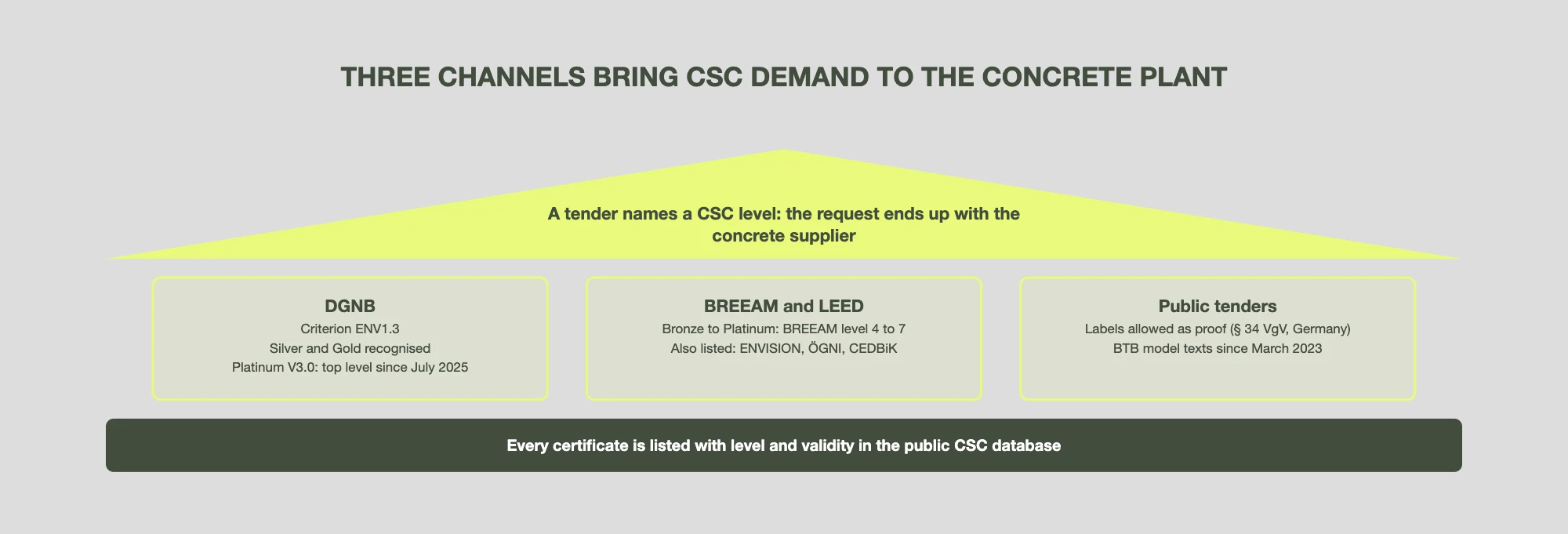
Figure 2: Three channels bring CSC demand to the concrete plant.
3.1 DGNB projects
The German Sustainable Building Council (DGNB) recognises CSC Silver and Gold in criterion ENV1.3. Since 10 July 2025, CSC Platinum V3.0 has also counted towards the highest DGNB quality level. The R module is officially recognised by the DGNB as evidence for secondary materials.
For a developer having a building certified under DGNB, each criterion is a building block for the targeted Silver, Gold or Platinum award. The DGNB auditor only awards points against evidence, and the simplest evidence is the CSC certificate of the supplying plant together with the delivery note. That is why, in our experience, the developer or their general contractor usually asks the concrete manufacturer as early as the planning phase whether a certificate exists and at which level.
3.2 BREEAM, LEED and other projects
The CSC lists recognitions in BREEAM, CEDBiK, ENVISION, LEED and ÖGNI. According to the CSC, in BREEAM Bronze corresponds to responsible sourcing level 4, Silver to level 5, Gold to level 6 and Platinum to level 7.
We often see international investors behind BREEAM and LEED projects who certify their entire portfolio and write proof of responsible sourcing into their construction contracts as a standard requirement. The general contractor passes this requirement on to its suppliers.
3.3 Public tenders
In public contracts, the requirement comes from procurement law. According to the German Environment Agency (Umweltbundesamt), public contracting authorities in Germany may include environmental requirements in the specification and ask for a specific label as evidence (§ 34 VgV). A municipality or a state agency can therefore write a CSC certificate or a module level into the bill of quantities, and the bidder must prove it with the bid.
Once the requirement is in the bill of quantities, the contractor has to meet it when buying the concrete. They ask the plants within reach who can deliver the required level. A plant without the required certificate cannot supply this item.
4. CSC certification with a recognised LCA tool
Environmental data play a role in two places in CSC certification: in the EPD criteria of the main certificate and in the CO2 module. In both cases, the CSC specifies which LCA tools may be used to create the life cycle assessment.
4.1 EPD criteria in the main certificate
In the main certificate, this concerns criteria group E1 "Environmental product information". It consists of four criteria worth 6 points in total plus 1 bonus point. For concrete plants, two of them are also minimum requirements for Gold and Platinum:
| Criterion | Points | Minimum requirement for | Met by |
|---|---|---|---|
| E1.01 Industry EPD | 2 | Gold, Platinum | Taking part in a national industry EPD or having the plant's own EPD (E1.03) |
| E1.02 CO2 information for customers | 2 | Gold, Platinum | Customer-specific CO2 calculation or the plant's own EPD with a public link |
| E1.03 Own verified EPD | 2 | none | At least one own, independently verified EPD, publicly linked |
| E1.04 Plant-level EPD | 1 (bonus) | none | A product-specific, verified EPD for the plant, publicly linked |
A recognised LCA tool such as Emidat can be used for the CO2 calculations. The plant-level EPD can also be created with the Emidat platform.
4.2 Evidence for the CO2 module
The annex to the CO2 module accepts two routes to evidence, a verified EPD or a self-declaration from an accepted LCA tool, and treats them differently.
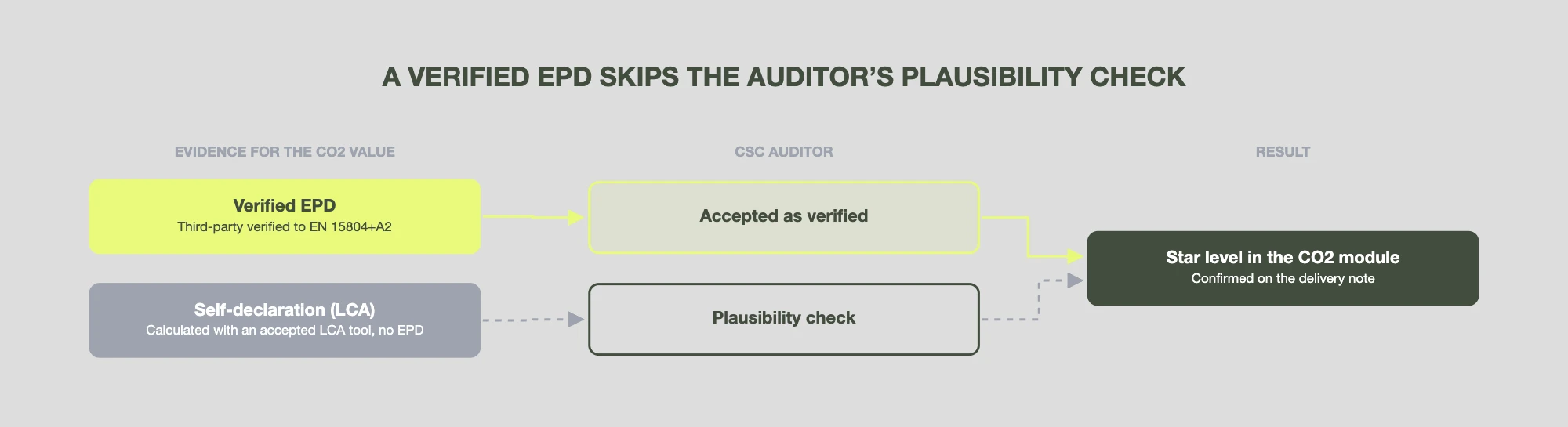
Figure 3: A verified EPD skips the auditor's plausibility check.
The difference lies in the review. A self-declaration, meaning an LCA from an accepted LCA tool without a published EPD, has not yet been checked by anyone outside the plant. That is why the CSC auditor carries out a plausibility check. An EPD has already been independently verified, so the CSC accepts it without a plausibility check.
5. Four steps to the CSC certificate and the add-on modules
1. Run the Quickscan
Start with the free Quickscan in the CSC Toolbox. Then check which of your cement and aggregate suppliers hold a CSC certificate and at which level.
2. Publish verified EPDs
A product-specific, verified EPD earns the points under E1.01 to E1.04, meets the EPD requirements for Gold and Platinum and serves as evidence in the CO2 module. In BREEAM projects, the same EPD also counts for the building, in criterion Mat 02, as our article How EPDs score in BREEAM shows.
3. Claim the module level
The level is confirmed in the annual declaration of conformity. So set it to the reduction your current cement reliably delivers.
4. Show your certificate and level
List the CSC level, module level and EPD links on your product data sheets and keep your entry in the public CSC database up to date. That way, your sales team can answer any question about CSC with a straight "yes".
FAQ
What is CSC certification for concrete?
CSC certification is an international certificate for concrete, cement and aggregate plants, issued under the system of the Concrete Sustainability Council. It assesses how responsibly a plant and its supply chain operate in environmental, social and economic terms, at four levels (Bronze, Silver, Gold, Platinum) and in the areas of prerequisites, management, environment, social, economy and supply chain. Regional system operators run the system in each country, in Germany the German ready-mixed concrete association (BTB); a certificate is valid for three years.
Is a CSC certificate the same as an EPD?
No. A CSC certificate assesses how a plant is run; an Environmental Product Declaration (EPD) states the environmental impacts of a product. The CSC uses EPDs as evidence: the plant's own verified EPDs earn points under criteria E1.01 to E1.04, and a verified EPD proves the CO2 value of a mix in the CO2 module.
Can I use my EPD as evidence for the CSC CO2 module?
Yes. The annex to the CO2 module (28 May 2025) accepts valid EPDs as already verified, so the CSC auditor does not carry out an additional plausibility check. A self-declaration, meaning a tool-based LCA without an EPD, is also accepted; in that case, however, the auditor checks the calculation for plausibility, and the plant must upload all background reports.
Does the R module count fly ash or slag as recycled material?
No. The R module only counts recycled, manufactured and reclaimed aggregate. Supplementary cementitious materials such as ground granulated blast-furnace slag, fly ash or silica fume are outside its scope; the main certificate considers them separately under criterion E7.05.
Is Emidat a recognised LCA tool for the CSC?
Yes. The annex to the CSC Technical Manual V3.0 of 5 December 2025 lists the Emidat EPD tool among the LCA tools accepted for EPD criteria E1.02 to E1.04. For the CO2 module, a verified EPD created with Emidat is accepted as evidence, because the module recognises valid EPDs as already verified.