
Customer case study- Novoferm
Novoferm brings EPDs in-house and scales to 80% portfolio coverage with Emidat
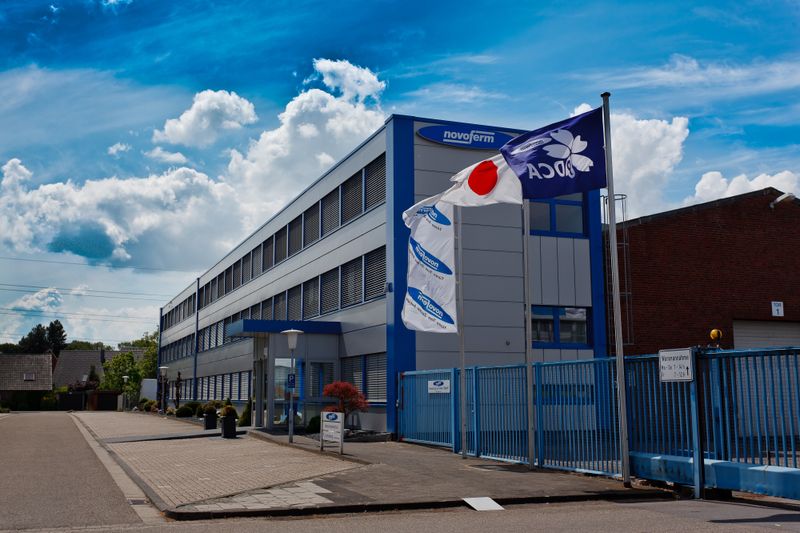
Novoferm is is one of Europe’s leading manufacturers providing door solutions and docking systems. Founded in 1955 and part of the Sanwa Group, the company operates production facilities in Germany, France, the Netherlands, Poland, and Italy, serving residential, commercial, and industrial customers across Europe. With thousands of employees and a broad product portfolio, Novoferm is a major player in the materials manufacturing industry.
To respond to rising customer demands and prepare for new regulations such as the Digital Product Passport, Novoferm set itself the goal of providing environmental transparency for over 80% of its products. To achieve this, the company turned to Emidat to digitalise and scale their EPD process.
Novoferm’s EPD process was entirely outsourced, leaving the company without visibility into how environmental results were produced. When customers requested an EPD, data was gathered manually across departments and sent to external consultants for modelling and verification. “We didn’t have any internal tools. Questionnaires were sent across departments, filled in, sent back, and based on that the EPD was created,” recalls Nell Stankewitz, Sustainability Manager at Novoferm.
The process ultimately fulfilled customer requests but offered little transparency. Novoferm’s teams couldn’t see how material or dataset choices influenced results, which limited their ability to translate the data into design or procurement decisions. “Dataset selection was done externally. With Emidat, since the knowledge is built internally, we benefit more,” says Stankewitz.
With Emidat, Novoferm gained full visibility and control over its EPD process. Updates could now be made independently and with this, much faster. “With Emidat, updates can be made instantly, unlike the old consultant model where each correction meant waiting for external partners or even restarting the entire process” says Stankewitz.
As the platform is intuitive, users with little prior LCA experience could get started quickly.
"
I had relatively little prior experience with EPDs. After a half-hour introduction, I could already work independently with the tool and teach myself the rest intuitively. That was super good - it was even fun to use.
"

Speed and scale have become major advantages of the new process. “I’d say it shortens things by at least three months per product,” notes Stankewitz.
"
And if you consider that a single EPD used to cost around €8,000 to €10,000, the license pays off after just the second or third EPD.
"

The new process now creates value beyond sustainability teams. “Various departments benefit - especially development, but also procurement and production. I also see potential in product management, because they’re interested in distributing documents and communicating material choices.”
Novoferm sees EPDs not only as preparation for upcoming regulation, but as part of its long-term product strategy.
The company's goal is to cover at least 80% of its portfolio with EPDs group-wide. With Emidat, Novoferm has built the capability to manage its EPD process entirely in-house and use it to continuously improve its products. “With Emidat, we not only save time and money - we actually build the knowledge inside our teams to make better products,” concludes Stankewitz.
For Novoferm, Emidat is a way to turn sustainability data into business value.