21.01.2026

·

3 min read

WHERE TO FIND AN EPD OR DPP: THE EPD DATABASE LANDSCAPE

Key Summary

  • Centralized Search for Verified Environmental Data: Emidat Atlas aggregates over 150.000 EPDs from various Program Operators into a single, free, and easy-to-use platform, simplifying access to reliable environmental product data for procurement, design, and sustainability assessments.
  • Effortless Data Organization: The platform organizes verified EPDs in a user-friendly interface, making it simple to browse by product category, region, or Program Operator without the need for complex filters or navigating between different data sources.
  • Future of Digital Product Passports (DPPs): The search tool serves as the foundation for a unified environmental data ecosystem and will evolve into a Digital Product Passport (DPP) and comparison tool, in line with the European Construction Products Regulation (CPR) to streamline data reporting and usage.

WHERE TO FIND ENVIRONMENTAL PRODUCT DATA?

An environmental product declaration (EPD) is a Type III Environmental Product Declaration. These type of declarations, following the ISO 14040 international standards, are verified by an independent third party and published by a Program Operator. There are roughly 30 relevant Program Operators in Europe, many of them with their own database. Hence, published environmental product data is scattered across different databases, formats and varying levels of trust depending on the Program Operator.

Organisations like Eco-Platform (Europe) and EC3 (United States) have been working on harmonising standards across Program Operators, increasing cross-recognition between them and aggregating their data. While these organisations are doing tremendously important work for the ecosystem, they don’t have the resources (or intention) to develop easy-to-use end-user tech products or ensure the data quality and consistency needed to work with this data.

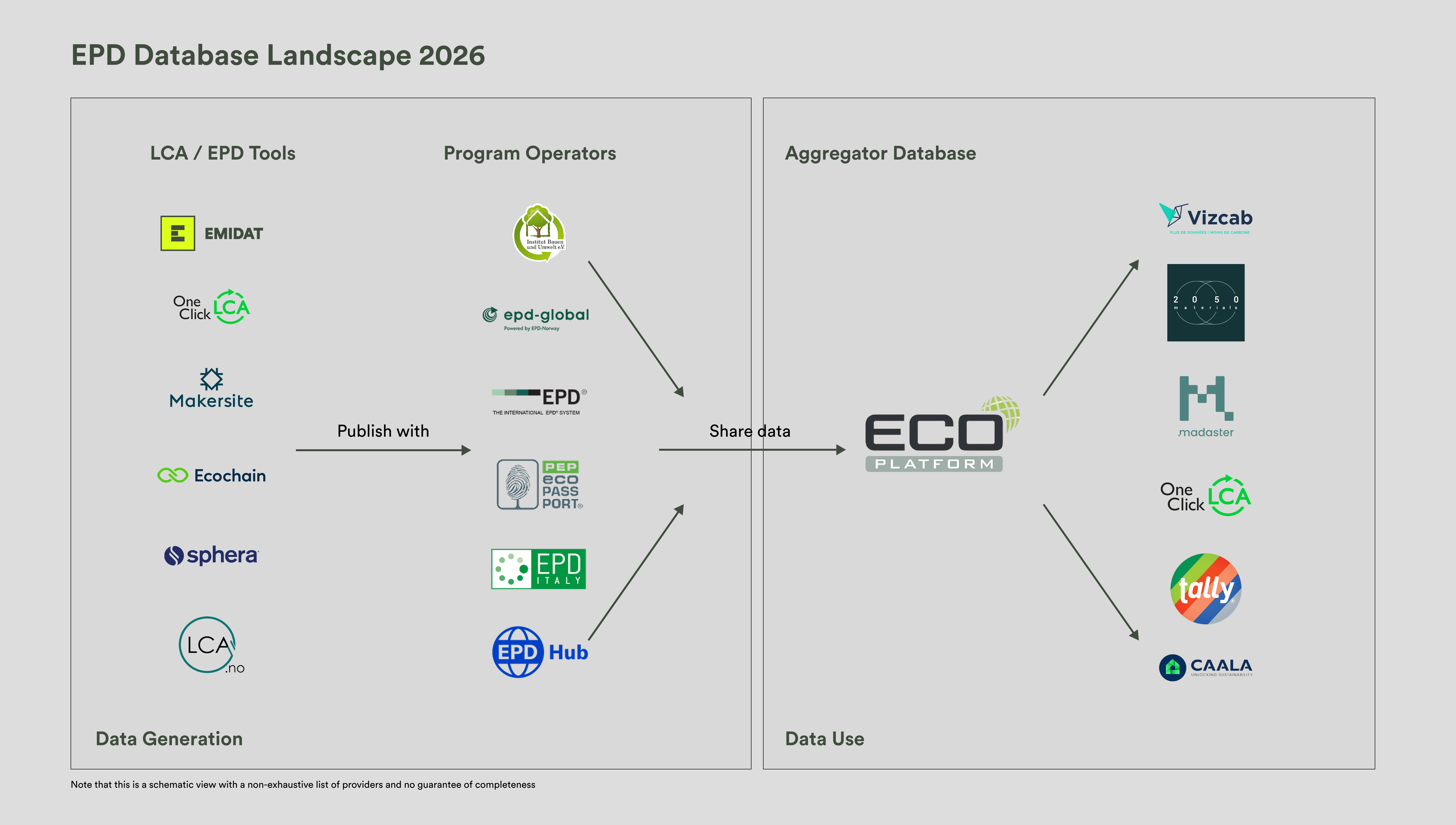
Today, the database landscape for EPDs looks something like this:

Existing EPD Database Landscape listing LCA and EPD tools such as Emidat, Sphera, LCA.no and others. It also shows the Program Operators such as IBU, EPD Global, and EPD Italy. The data is shared with Aggregators such as Eco Platform, and used by tools such as CAALA, 2050 Materials, and other providers

HOW IS MY PRODUCT DATA BEING USED?

We see two types of solutions addressing these problems to enable data use:

  1. Tech companies earning money on making the data usable

Focusing on the user side of the environmental product data, it is usually planning or procurement. In construction, there are several building-level LCA tools that are targeted to architects and project developers. They earn money to make the environmental data easy to use, they “consume” data from these databases. These solutions enable developers to demand higher prices for their buildings (e.g. through certifications like LEED, BREEAM, DGNB), receive more beneficial conditions in their bank loans (e.g. with QNG) or comply with national law (e.g. staying within CO2 thresholds in the Netherlands or Denmark). They are economically dependent on providing value to the end user.

  1. National databases with additional quality requirements

To ensure data quality, there are rigid national databases like the Ökobaudat (Germany) and the NMD (Netherlands), who only allow specific Program Operators to publish in them, often with additional requirements and quality checks. This makes sense, because these databases usually tie the environmental impact of products to financial incentives, so tender processes, interest rates of bank loans and large investment decisions depend on their accuracy. Their job is to make the environmental impact assessment of products comparable.

However, there is also criticism that this is against the idea of an open Single Market and at Emidat, we see this problem in practice everyday: A German producer selling to several European markets needs to redo their environmental data for France (publishing in INIES), the Netherlands (publishing in NMD) and the rest of Europe (publishing through EPD Global or EPD International to Eco-Platform). They pay three times for three different consultants and three different publishers to calculate the very same product, gathering documents but not relevant information to reduce. Yet they are forced to do so, because they cannot otherwise sell their product in the local markets.

This is where the Construction Products Regulation (CPR) aims to harmonise standards across Europe. It aims to simplify and unify the environmental accounting that is already happening nationally today and to aggregate all product reporting in the digital product passport (DPP). If done well, this should actually reduce, not increase paperwork for manufacturers!

It’s the Bloomberg moment in environmental accounting.

How will the CPR change the database landscape?

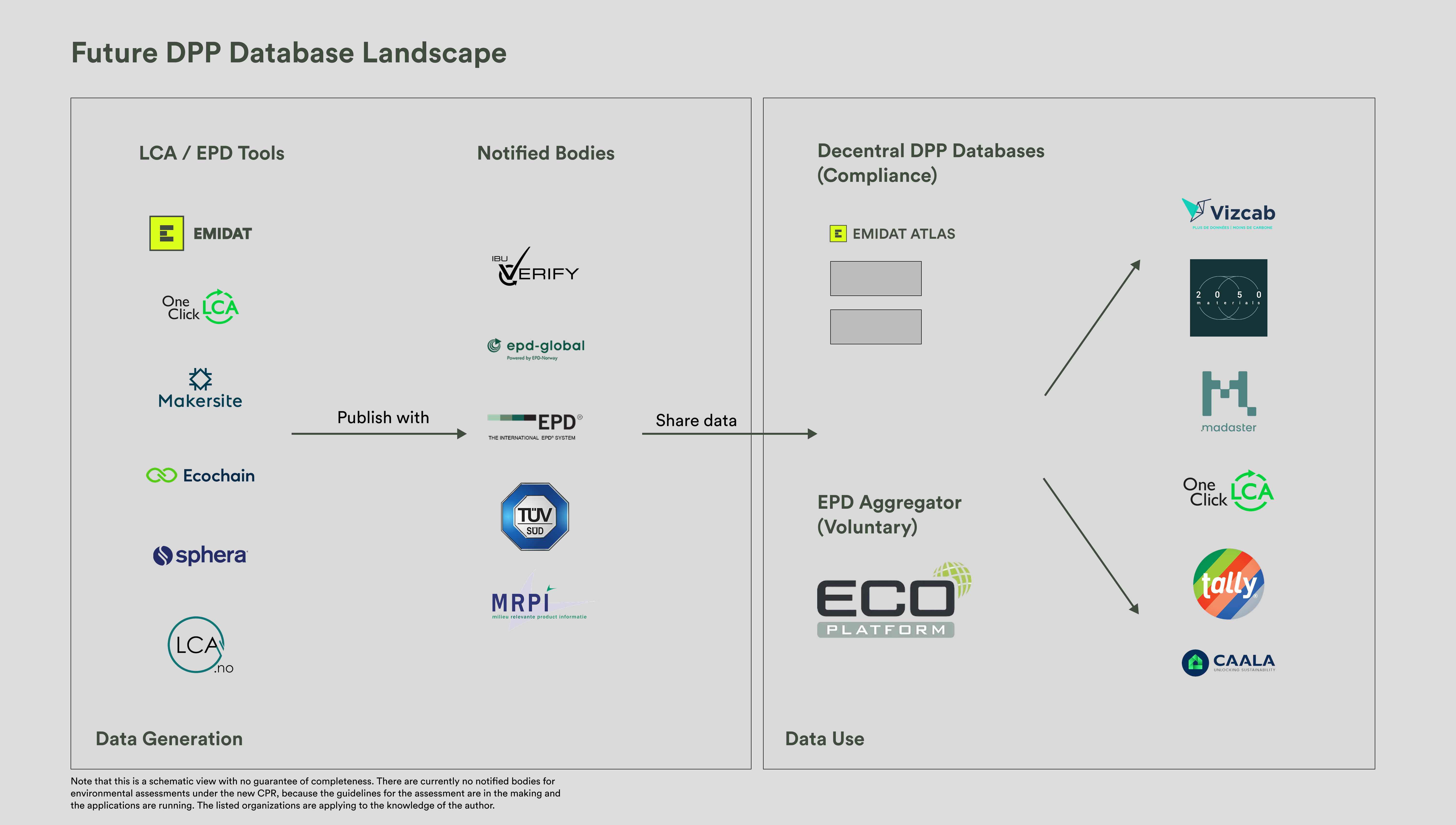
It has already been communicated by the European Union, that they will not offer one central database for DPPs, but instead there will be several decentral databases by private providers that need to follow set guidelines and allow you to easily transfer data from one to another, so you can choose the one that suits your needs best. This is similar to mobile infrastructure providers: They host your phone number, but need to allow you to easily transfer it to another if you with to switch.

It is unclear which private providers will provide these databases in the future, but the Emidat Atlas will evolve into one of them.

Future DPP Database Landscape showing various LCA tools such as Emidat, Makersite, Sphera, amongst others. The landscape also shows examples of Notified Bodies such as EPD Global and EPD International. Next, DPP Databases such as Emidat Atlas, and data users such as CAALA and 20250 Materials are shown

INTRODUCING THE EMIDAT ATLAS

With many tools focused either on end users’ needs or national high-quality data, an obvious gap emerged. A simple, free and high-quality search that makes the tediously assembled verified product data easily accessible. At Emidat, we believe finding and interpreting product data should and will be for free.

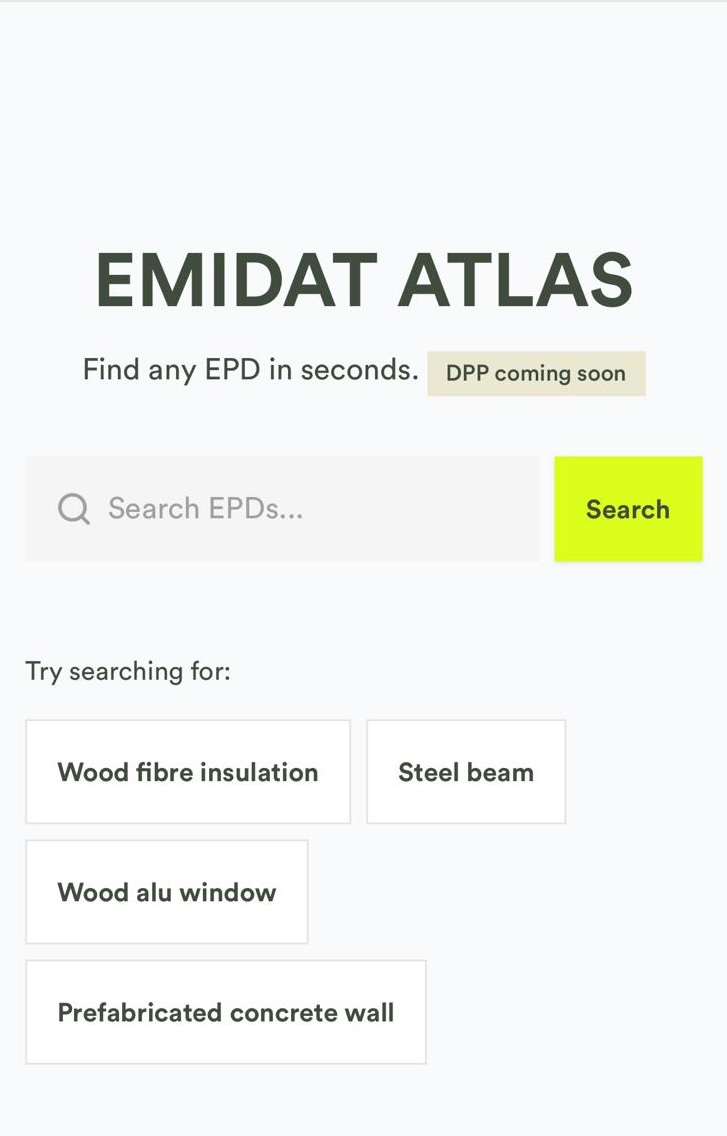
We have aggregated, enriched and cleaned available data covering more than 150.000 products globally. We have built a beautiful, easy-to-use interface and we are launching the Emidat Atlas as your free search to find and work with environmental product data. The tool brings verified EPDs from multiple Program Operators together in one place and presents them in a way that is simple to search, navigate, and understand. It is meant to help anyone who needs reliable information quickly, whether for procurement decisions, design choices or sustainability assessments, without moving between different databases or formats, and always keeping the link to the original database.

Emidat is the first tech company that can cross-finance this search through high-quality EPD creation for manufacturers. This search is and will stay free for users and will become a DPP/CPR-compliant database in the future.

With it, you can:

  • Search and filter verified product data in one place - ensuring that your EPD is actually verified and published
  • Browse by product category, region or Program Operator
  • Scan key indicators through clear summaries
  • Jump directly to the original source via link
  • Soon: Compare and benchmark products

This launch lays the foundation for a unified environmental data ecosystem where EPDs and Digital Product Passports can be found, understood, and used across the entire product lifecycle.

The search tool is available now, and it is free 💚. Access it here.

what to look forward to next

We are now building the next wave of features that will make the platform even more powerful. A dedicated comparison view is on the way, more Program Operators are being added, and API access will open the door to deeper integrations. A chatbot will support common tasks and help users navigate the data more easily. If you want to be among the first to use these new releases, join the waitlist and follow the progress as each feature goes live.

Automate your epds.
Contact US.

By submitting this form, you agree to be contacted by us by email and acknowledge that your contact details will be stored by us.

Thank you! Your submission has been received!
Oops! Something went wrong while submitting the form.