What is a PCF? A quantification of a product's greenhouse gas emissions (CO₂e) across its lifecycle, focused solely on climate impact.
What is an LCA? A standardized method for evaluating the environmental impacts of a product across all stages of its lifecycle, covering multiple impact categories.
What is an EPD? A third-party verified, standardized document that uses LCA data to transparently report a product's environmental impacts across multiple environmental indicators.
When manufacturers report product-specific environmental data, three common formats come into play: Product Carbon Footprints (PCF), Life Cycle Assessments (LCA), and Environmental Product Declarations (EPD). While these formats are closely related, they differ in scope, verification level, and intended use. This article breaks down each format so you can understand which one fits your needs.
1. Product Carbon Footprint (PCF) – The Carbon-Only View
A Product Carbon Footprint (PCF) is the simplest of the three formats. Instead of reporting on multiple environmental indicators, it focuses on just one: greenhouse gas emissions measured in CO₂ equivalents (CO₂e). This makes it significantly easier to calculate, understand, and compare.
A PCF is based on ISO 14067 and can be independently verified. Some industry standards and customer requirements specifically call for a verified PCF. However, verification of a PCF is not as standardized or widely established as the third-party verification process for EPDs.
How Does a PCF Relate to an LCA?
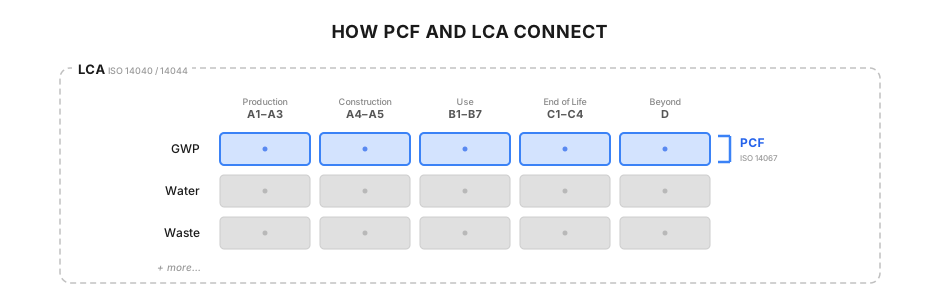
A PCF can be thought of as a subset of an LCA. When you perform a full LCA, one of the impact categories calculated is Global Warming Potential (GWP), measured in CO₂ equivalents (CO₂e). This GWP result is essentially your PCF. That's why many software platforms can automatically provide a PCF alongside a full LCA.
What Can a PCF Be Used For?
✓ Responding to customer requests for carbon data, especially in industries like automotive or steel
✓ Quick carbon benchmarking of products
What Should a PCF Not Be Used For?
✗ Fulfilling customer requests in the construction industry, where full LCA data via EPDs is typically required
✗ Regulatory compliance under the Construction Products Regulation (CPR), which requires full environmental data
2. Life Cycle Assessment (LCA) – The Full Picture
A Life Cycle Assessment (LCA) is a standardized method for quantifying a product's environmental impacts across its entire life cycle. It follows the ISO 14040 and ISO 14044 standards.
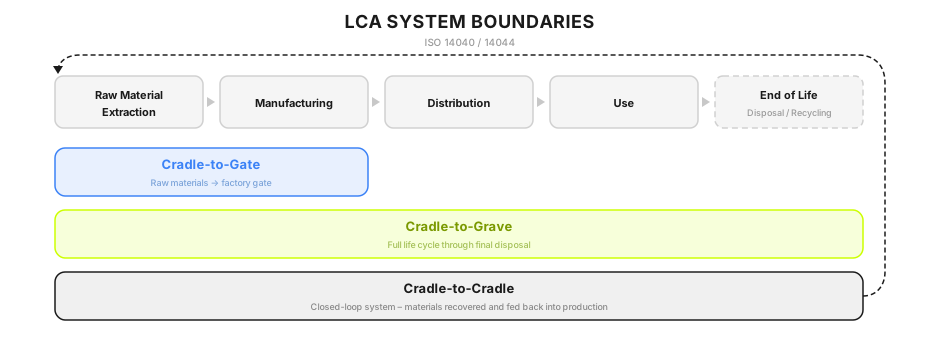
A key decision in any LCA is the system boundary, meaning how much of the life cycle should be analyzed in the study. The following system boundaries are commonly used in product environmental reporting:
Cradle-to-Gate: Covers raw material extraction, transport, and manufacturing up to the factory gate.
Cradle-to-Grave: Extends beyond the factory gate to include distribution, the use phase, and end-of-life treatment.
Cradle-to-Cradle: Includes recycling or reuse loops, where materials are recovered and flow back into a new product system.
Unlike a PCF, which focuses only on greenhouse gas emissions, an LCA can cover multiple environmental indicators such as climate change, ozone depletion, acidification, eutrophication, resource depletion, water use, and more.
LCAs as the Basis of EPDs in Construction
When LCAs are created as the basis of EPDs for the construction sector, they must follow EN 15804+A2 and include all required environmental indicators. This means an LCA created for an EPD goes far beyond just greenhouse gas emissions - it also covers indicators such as ozone depletion, acidification, eutrophication, resource depletion, and water use.
In the construction industry, the life cycle stages are organized into standardized modules according to EN 15804+A2:
Stage
Modules
Description
A – Production
A1–A3
A1: Raw material supply
A2: Transport to manufacturer
A3: Manufacturing
A – Installation
A4–A5
A4: Transport to construction site
A5: Installation process
B – Use
B1–B7
B1: Use
B2: Maintenance
B3: Repair
B4: Replacement
B5: Refurbishment
B6: Operational energy use
B7: Operational water use
C – End of Life
C1–C4
C1: Demolition
C2: Transport
C3: Waste processing
C4: Disposal
D – Beyond
D
Net benefits from reuse
Recycling
Energy recovery
The Product Category Rules (PCR) for a specific product type define which life cycle stages must be declared for the LCA to serve as the basis of an EPD.
What Can an LCA Be Used For?
✓ Understanding the full environmental impact of your product
✓ Identifying environmental hotspots for product improvement and ecodesign
✓ Understanding which life cycle stage has the largest impacts
✓ Internal benchmarking and comparing product variants
✓ If verified: Compliance with the Construction Products Regulation (CPR)
What Should an LCA Not Be Used For?
✗ External communication or marketing claims about environmental performance (without third-party verification)
✗ If not verified: Compliance with the Construction Products Regulation (CPR)
An Environmental Product Declaration (EPD) is a standardized, third-party verified document that communicates the environmental performance of a product. It is based on the same underlying methodology as an LCA and reports the same environmental indicators, but with one critical difference: an EPD has been independently verified by an accredited third party.
This verification step is what makes EPDs the gold standard for external environmental communication. EPDs are published through program operators (such as EPD Global, EPD International, or IBU) and follow strict rules defined in Product Category Rules (PCRs) and, for construction products, the EN 15804+A2 standard.
What Can an EPD Be Used For?
✓ Responding to customer requests for verified environmental data
✓ Strategically positioning sustainable products in the market
✓ Contributing to green building certifications (LEED, BREEAM, DGNB)
✓ Calculating and reporting Scope 3 emissions with externally credible data
✓ Preparing for compliance with the Construction Products Regulation (CPR), which will require verified LCAs following EN 15804+A2
Limitations to Keep in Mind
✗ EPDs are not designed for direct product-to-product comparisons unless done very carefully
✗ The verification process requires time and investment if not automated
How Do PCF, LCA, and EPD Connect?
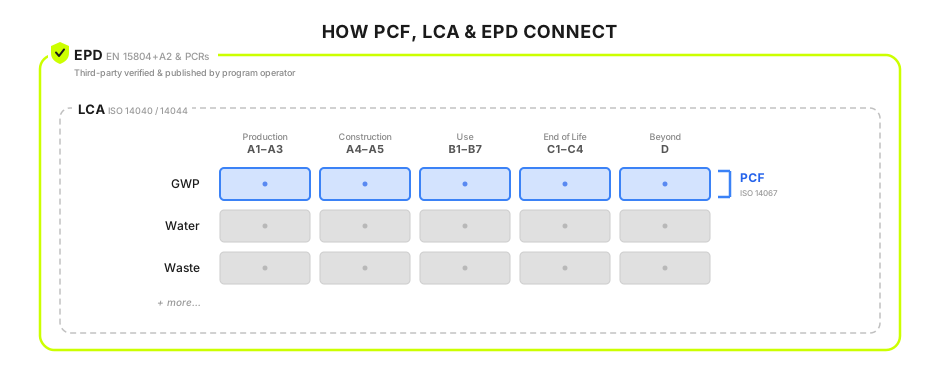
The three formats are not independent – they build on each other:
Start with an LCA: The LCA is the foundational analysis. It can be used to analyze the full set of environmental indicators across all life cycle stages.
Extract the PCF: The PCF can be derived from the LCA by isolating the GWP indicator. Many software platforms extract this automatically.
Verify for an EPD: An LCA that follows EN 15804+A2 and the relevant PCR can be used as the basis for an EPD, which is then third-party verified and published through a program operator.
Upcoming: Digital Product Passport (DPP) – The Digital Layer
The Digital Product Passport (DPP) is a digital data carrier introduced by the EU that will change how environmental product data is shared and accessed. Think of it as a digital ID card for your product – a structured, machine-readable dataset that travels with the product throughout its entire life cycle.
Accessible via a QR code on the product itself, a DPP doesn't replace your PCF, LCA, or EPD. Instead, it acts as the digital container that carries this data forward in an interoperable, standardized format.
How Emidat Can Help
Emidat is the leading platform trusted by over 150 manufacturers to automate the creation of PCFs, LCAs, EPDs, and DPPs in-house – without requiring any prior LCA expertise. Get in touch below.